The Plan
A specific plan. Clear limits. Long-term stewardship.
The Proposal
Mycelia proposes to adaptively reuse the existing Greystone Estate as a small, extended-stay residential treatment center serving no more than 30 adults. The program would operate principally within Greystone's existing buildings and developed campus rather than creating a new institutional facility or substantially expanding development across the property.
The plan concentrates treatment, residential activity and supporting uses within the established campus, relies substantially on existing buildings, access and infrastructure, and minimizes new land disturbance. The Planned Development (PD) zoning creates a property-specific framework rather than broadly opening Greystone to commercial or institutional uses.
The result is a carefully tailored plan and zoning framework that allows Mycelia to operate at Greystone under clear, property-specific and enforceable standards governing the scale and intensity of the use, while preserving the Estate’s setting and natural separation from the surrounding community.
Why Planned Development Rezoning?
A Residential Treatment Center is already a use Jefferson County can consider on the A-2 portion of Greystone through the County's Special Use process. The residential treatment use itself is therefore not the reason Mycelia is requesting Planned Development zoning.
The PD is requested because Mycelia's treatment model also includes a Colorado-regulated Natural Medicine Healing Center as an accessory component of the residential program. Jefferson County treats a Healing Center as the zoning equivalent of a medical or dental office, requiring different zoning authorization. The PD allows the Residential Treatment Center and its accessory Healing Center to be considered together within one property-specific land-use framework.
This is not a request for blanket commercial zoning.
The proposed PD is tailored specifically to Mycelia at Greystone. The Residential Treatment Center remains the principal use, while the Healing Center is accessory and subordinate to that program and would not operate as a stand-alone facility serving the general public.
What the Plan Limits
The PD and Official Development Plan are intended to establish the core land-use rules for Mycelia at Greystone — the things that should remain clear and enforceable over time.
30 Residents Maximum
A defined upper limit on the residential treatment program.
Use the campus that is already here
Mycelia will operate principally within Greystone's existing buildings and developed areas.
Residential treatment is the principal use
The property is being zoned around this specific residential treatment model.
Limited new development
New improvements associated with Mycelia are intended to remain incidental and subordinate to the existing campus.
Extended-stay residential use
A minimum 30-day stay, with an anticipated average stay of approximately six weeks.
Integrated healing center
It is integrated into the residential treatment model and not open to the general public.
Details
The Site
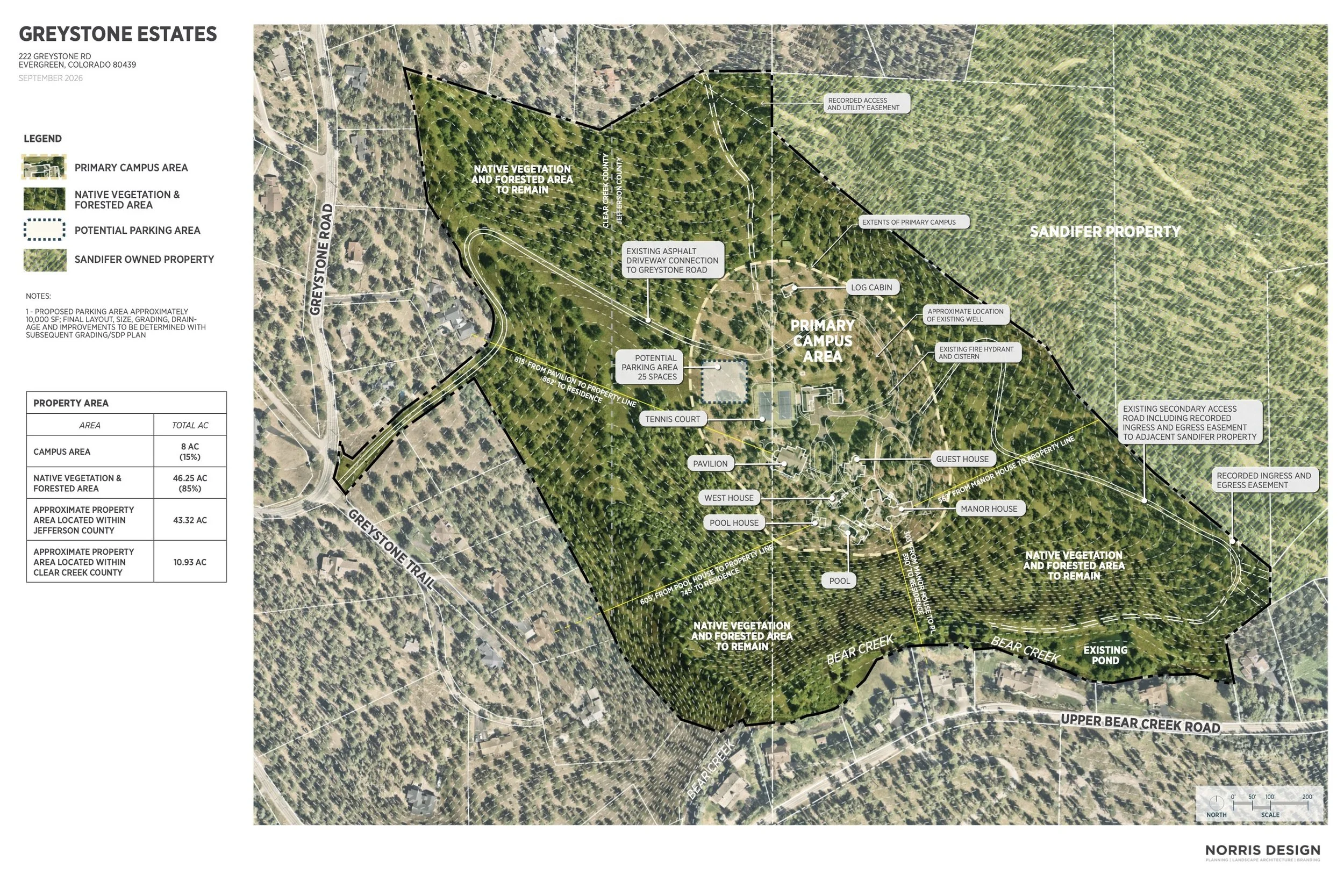
Greystone's buildings and developed areas are concentrated within a relatively small portion of the approximately 54-acre Estate. Around that campus are substantial areas of mature forest, meadow, rock outcroppings, steep and varied topography and the Upper Bear Creek corridor. Those existing conditions already provide significant physical separation between the campus and surrounding properties.
Mycelia's plan keeps the treatment program concentrated within the established campus rather than extending development and activity across the Estate. That approach minimizes new land disturbance while allowing the surrounding forested acreage, topography and open land to continue serving as a natural buffer between Greystone and neighboring properties.
To the west in particular, approximately 10 acres of Greystone in Clear Creek County remain between the primary campus and properties farther west. That area is predominantly undeveloped, forested and topographically varied, and no principal Mycelia campus development or operational activity is proposed there.
Traffic
Mycelia is designed around residents living at Greystone for extended stays — approximately six weeks on average — rather than coming and going for treatment each day. Residents will not be permitted to keep personal vehicles on the Greystone property. Transportation for arrivals, departures, appointments and other program needs will be coordinated through Mycelia.
As a result, daily vehicle activity will come primarily from staff shifts, scheduled visitors, deliveries and service providers, and coordinated resident transportation. The project’s traffic engineer evaluated the proposed program and concluded that projected traffic volumes would be minor and are not expected to negatively affect surrounding roadway operations or the existing Greystone access.
6 WEEKS
Average residential stay
NO RESIDENT VEHICLES
Personal vehicles will not be permitted on the property
COORDINATED
TRANSPORTATION
Resident transportation managed through Mycelia
MINOR TRAFFIC IMPACT
No expected negative impact to surrounding roadway operations
How does that compare with residential development?
Greystone’s existing zoning allows additional single-family residential development. As part of the required traffic analysis, the project engineer compared Mycelia with residential development permitted under the property’s current zoning using standard Institute of Transportation Engineers trip-generation rates.
That analysis found that Mycelia would generate substantially less traffic than the maximum residential development scenario evaluated under the existing zoning.
The maximum-zoning scenario is not a proposed subdivision or a prediction of how many homes could ultimately be developed at Greystone. It is a standardized zoning comparison. But it illustrates an important difference between the two development patterns: Mycelia would reuse the existing Greystone campus, with residents staying for extended periods and without personal vehicles, rather than creating multiple independent residential households generating their own daily trips.
For context, the same traffic study uses the standard ITE rate of 9.09 daily vehicle trips for each detached single-family home.
MYCELIA AT GREYSTONE
Adaptive reuse of the existing campus
Extended residential stays
No resident vehicles
Coordinated transportation
ADDITIONAL RESIDENTIAL DEVELOPMENT
Multiple independent households
9.09 daily trips per detached home
Standard ITE traffic-generation rate
The project traffic study found Mycelia would generate less traffic than the maximum residential development scenario evaluated under Greystone’s existing zoning.
Fire Mitigation
Greystone is a forested mountain property, and wildfire preparedness is a serious part of its long-term stewardship. Mycelia has submitted a site-specific Wildfire Hazard Mitigation Plan addressing defensible space, forest management, emergency access, fire-resistant improvements and ongoing maintenance. The plan is now being reviewed through the Jefferson County rezoning process to establish the wildfire mitigation requirements appropriate for Greystone.
Significant mitigation has already occurred across the developed campus. More than 300 trees have been removed, increasing separation between tree crowns and reducing forest density. Vegetation and ladder fuels have been cleared around buildings, and additional thinning has occurred through ongoing forest-health and mountain pine beetle management. Greystone also has substantial on-site fire-suppression resources, including a 20,000-gallon buried cistern connected to a hydrant, a 10,000-gallon irrigation tank, an approximately 48,000-gallon pool and a pond.
The PD rezoning is putting Greystone through a site-specific level of wildfire review that the existing Estate is not otherwise undergoing. The mitigation plan calls for continued defensible-space maintenance, forest thinning and crown separation, removal of ladder fuels and unhealthy vegetation, protection of emergency access and ongoing forest-health work. Those measures are designed to reduce the potential for high-severity crown fire and improve the resilience of the property over time. Mycelia will take responsibility for carrying that work forward as the long-term steward of Greystone — maintaining what has already been accomplished and continuing to invest in the health and safety of the property and surrounding forest.
Wildfire risk is real. Managing it has to be ongoing.
Greystone will be a non-smoking campus.
Safety & Supervision
Mycelia is designed for adults who can safely participate in this level of residential treatment. Prospective residents will go through a rigorous clinical screening process before admission. Individuals requiring detoxification, acute stabilization or another level of care beyond what Mycelia provides will not be admitted and will instead be referred to an appropriate provider.
Professional staff will be present around the clock. Access to the campus will be controlled, residents will remain primarily at Greystone during their stay, and off-site appointments and program activities will be planned and coordinated with appropriate staff oversight and transportation.
Mycelia will also maintain emergency-response and evacuation procedures appropriate to both a residential treatment setting and Greystone's mountain environment, including planning for medical and behavioral-health emergencies, wildfire, severe weather and evacuation. Those plans will be coordinated with Evergreen Fire/Rescue and other applicable emergency-response agencies.
A structured residential setting with professional oversight